The STX Resilience Campus is designed around a fully integrated water, wastewater, and storm-management
system that allows the site to operate independently from centralized infrastructure for extended periods.
This system is not an afterthought—it is a core pillar of the $130M (Phase 1) campus plan
and a prerequisite for functioning as a true resilience hub for St. Croix.
Last updated: 2026-01-24
Water Systems Snapshot
Campus footprint40-50 acres with integrated drainage corridors
Monitoring & controlVault-integrated sensors for levels, pumps, quality
Water Resilience Mission
The water systems are built on four strategic goals:
Reliability: Maintain safe, sufficient water supply during grid failures and storm disruptions.
Redundancy: Layer multiple sources—rainwater, stored potable, trucked water, and public mains.
Safety & Quality: Ensure potable water meets health standards even under degraded conditions.
Environmental Stewardship: Capture, reuse, and manage water in a way that protects local ecosystems.
Integrated Water Supply Strategy
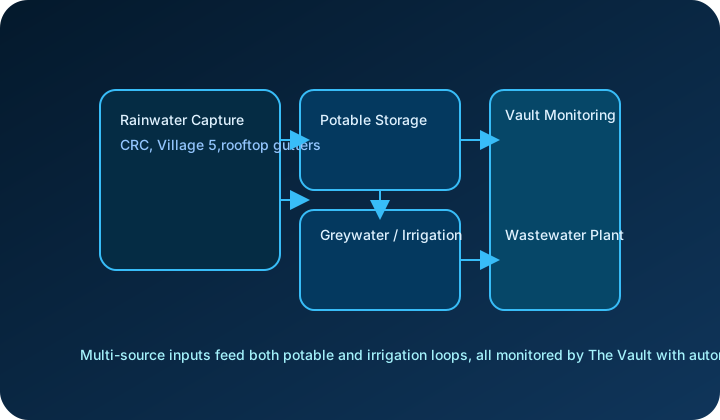
The campus water strategy is deliberately multi-sourced to avoid single points of failure. The system integrates:
Rainwater harvesting from major roof surfaces and covered structures.
On-site potable storage in elevated and ground-level tanks.
Connection to public water mains where available, with backflow protection.
Truck-fill access for emergency replenishment via tanker delivery.
This design ensures that even if one or more sources are compromised, the campus can continue to operate.
Rainwater Harvesting & Cisterns
Rainwater is a primary resilience asset for the campus. Roofs over the CRC, Village 5, staff housing,
agricultural facilities, and auxiliary buildings are engineered as collection surfaces feeding a
network of cisterns and storage tanks.
Gutter and downspout design sized for intense tropical rainfall rates.
First-flush diversion to remove debris and initial contaminants.
Pre-filtration at inlets to reduce sediment loading.
Buried and above-grade cisterns with hurricane-resistant anchoring.
Level monitoring connected to The Vault for real-time status.
Captured rainwater is allocated for irrigation, flushing, cleaning, and—in properly treated pathways—
for potable or near-potable applications as required.
Potable Water Storage & Distribution
Potable water is stored in dedicated, food-grade tanks with tightly controlled treatment and monitoring:
Redundant storage capacity sized for multi-day autonomy at full occupancy.
Elevation and pressure management using a combination of gravity and pump systems.
Multi-stage filtration (sediment, carbon, UV or chlorination as appropriate).
Distribution loops to Village 5, CRC, The Vault, housing, kitchen, stables, and medical spaces.
Sampling points for ongoing water quality verification.
The goal is simple: even if island supply is unstable, campus taps and fixtures continue to deliver safe water.
Critical Water Loads in Disaster Mode
In emergency conditions, the water system enforces a priority structure mirroring the power microgrid:
Tier 1: Drinking water, kitchen, medical stabilization, and critical sanitation.
Tier 2: Shelter hygiene (CRC showers and restrooms) and essential cleaning.
Tier 3: Livestock and equine therapy water, limited irrigation for food security.
Tier 4: Non-essential uses, deferred or shut off in extended crisis.
This ensures that health and life-safety functions are supported first and kept online the longest.
Wastewater Treatment & Reuse
The campus is designed with a modern wastewater system that can integrate with public infrastructure
where available but is not dependent on it for survival. The approach incorporates:
Segregated blackwater and greywater streams where practical.
On-site treatment capacity sized for full-occupancy conditions.
Effluent quality controls to meet or exceed regulatory discharge standards.
Potential reuse of treated greywater for irrigation and non-potable functions.
Wastewater infrastructure is concentrated in a location that also supports agricultural and stables operations,
enabling efficient reuse and minimizing environmental impact.
Stormwater Management & Flood Resilience
Tropical storms and hurricanes can produce extreme rainfall and runoff. The campus grading and drainage plan
is designed to protect buildings and infrastructure while reducing erosion and downstream impacts:
Graded site topography that channels water away from structures.
Swales, bioswales, and retention areas to slow and infiltrate stormwater.
Heavy-duty drainage inlets and culverts at key low points.
Permeable surfaces where feasible to reduce runoff volume.
Protection of ELZ and access routes to maintain usability after storms.
Stormwater design is tightly integrated with building placement, circulation paths, and the location
of critical infrastructure zones.
Integration with Agriculture & Stables
The water system is not only about survival; it also supports the campus as a
socio-economic and therapeutic engine. Key integration points include:
Irrigation of greenhouses and orchards using rainwater and treated non-potable sources.
Water supply for stables and equine therapy with priority protections in disaster-mode.
Reuse of treated wastewater (where safe and compliant) to support agricultural operations.
Shared pumping and storage infrastructure that links water, agriculture, and animal care.
This closed-loop approach supports food security, animal welfare, and therapeutic programming.
Monitoring, Controls & The Vault
The Vault serves as the monitoring and control hub for key water and wastewater components:
Tank level monitoring for cisterns and potable storage.
Pump status and alarms for critical lift stations and booster pumps.
Flow and pressure data for main distribution lines.
Quality sensors where deployed for key points in the system.
When combined with the microgrid, this monitoring allows the campus to balance power and water usage
in a coordinated way, especially during extended emergency operations.
Public Health, Hygiene & Shelter Operations
During major events, the campus may shelter hundreds of people across Village 5 and the CRC.
The water and wastewater systems are sized and configured to:
Provide sufficient drinking water for residents, staff, and evacuees.
Maintain sanitation and hygiene at safe, dignified levels.
Support continuous kitchen operations for mass feeding.
Enable post-disaster cleanup and disease-prevention measures.
This is essential not only for physical health but also for maintaining morale and psychological stability
in prolonged crisis conditions.
Regulatory & Environmental Considerations
The water and wastewater systems are designed to align with U.S. Virgin Islands regulations and broader
environmental standards, including:
Appropriate permitting for wells, cisterns, and wastewater systems.
Compliance with discharge standards and setback requirements.
Stormwater design consistent with erosion and runoff guidelines.
Protection of local watersheds and sensitive areas.
By design, the campus aims to improve resilience without creating new environmental burdens.
Water Systems as a Core Pillar of the $130M (Phase 1) Campus
From rainwater harvesting and potable storage to wastewater treatment and stormwater management,
the water systems are central to the campus mission. They enable long-duration sheltering, daily
operations, agricultural productivity, animal care, and community support—even when the surrounding
infrastructure is damaged or offline.
In short, the water system is one of the key reasons the STX Resilience Campus can operate as a
genuine resilience hub, a humanitarian asset, and a long-term regional anchor for St. Croix.
How This Component Delivers on the Five Pillars
Five core pillars are shown first; supporting highlights are labeled.
Humanitarian Impact
Ensures drinking water, sanitation, and kitchen operations for 500+ residents and evacuees even if public mains fail.
Keeps CRC sheltering and medical stabilization safe during prolonged emergencies.
Local Workforce Development
Creates training pathways in water treatment, plumbing, environmental tech, and storm-management for veterans/residents.
Links to agriculture and stables programs so participants learn closed-loop resource management.
Scalable & Replicable Model
Documented cistern, wastewater, and drainage designs can be reused on future VP campuses or partner facilities.
Priority scripts mirror the microgrid hierarchy, providing a template for other islands.
Integrated Economic Self-Sufficiency
Reduces utility costs via rain capture, treatment, and reuse; prevents expensive post-storm repairs.
Supports agriculture output and equine programs, creating revenue while limiting imports.
Operational Resilience
Multi-source supply, automated monitoring, and drainage infrastructure keep the campus livable during hurricanes.
Wastewater and storm systems protect the ELZ, Village 5, and roads so relief logistics can continue.
Supporting System
Environmental Stewardship
Protects wetlands and nearby coastal corridors by managing discharge quality and flow pacing.
Provides data to agencies and funders demonstrating how water, agriculture, and waste loops reinforce each other.
Water & Utility Diagrams
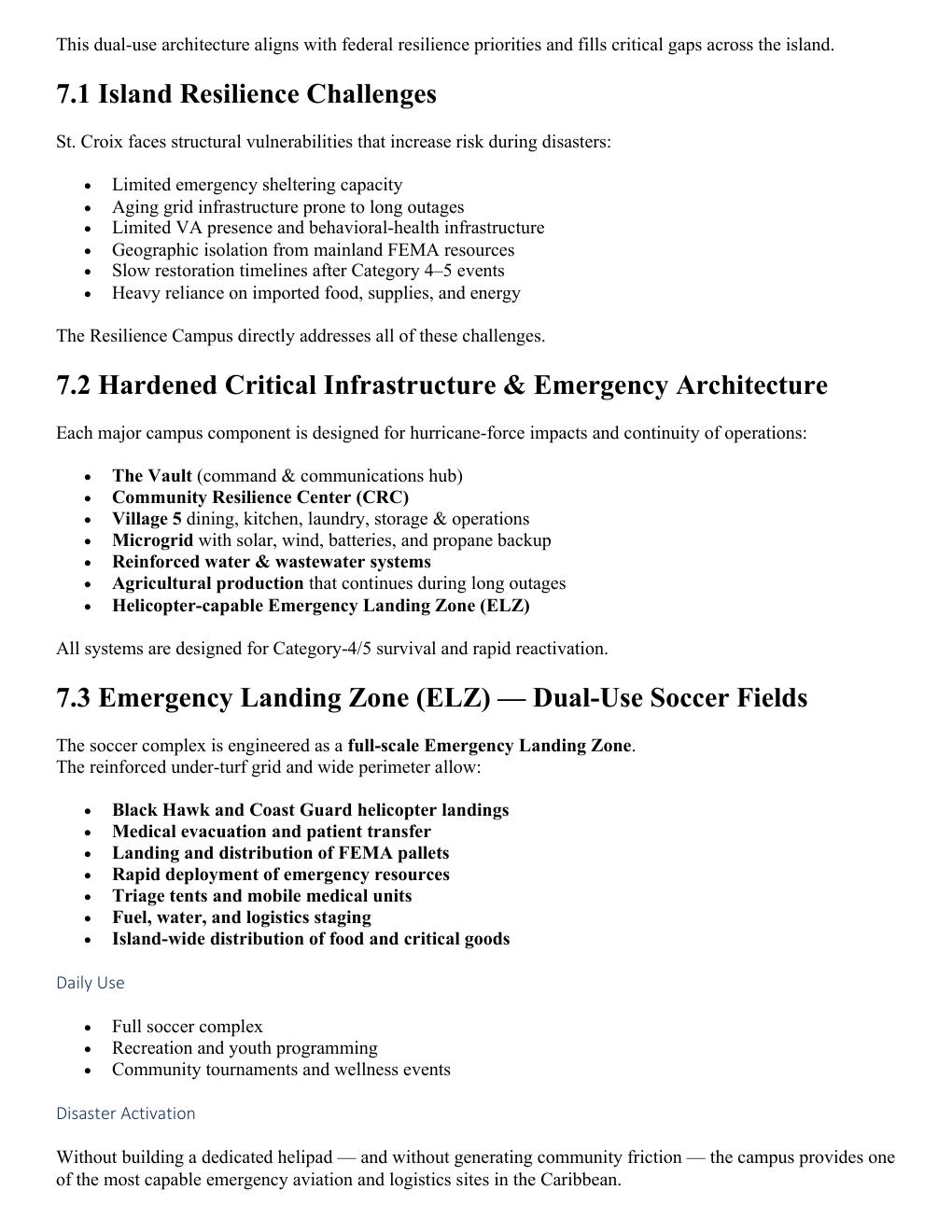
Multi-source supply, potable storage, greywater reuse, and Vault monitoring.Concept slide describing integrated water, wastewater, and storm protection.Submitted plan excerpt detailing cisterns, treatment, and distribution.
Search the site
Connect with STX Vets Project
Message our team
Whether you represent investors, federal partners, local government, or you are an individual supporter, we would love to hear from you. Choose the option that fits best and send us a note.