Emergency Landing Zone (ELZ) & Soccer Fields
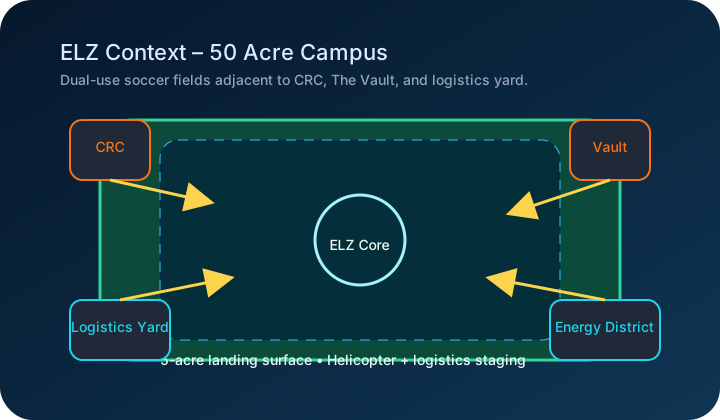
The Emergency Landing Zone (ELZ) is one of the most strategic dual-use assets of the STX Resilience Campus. Designed in normal conditions as high-quality multi-use soccer fields and recreation space, the ELZ converts rapidly into a helicopter landing zone, logistics staging area, and forward operating field for disaster response.
This district is planned explicitly through the campus’ Five Pillars: Humanitarian Impact, Local Workforce Development, Scalable & Replicable Model, Integrated Economic Self-Sufficiency, and Operational Resilience.
ELZ Snapshot
Pillar 1 – Humanitarian Impact
During major storms, earthquakes, or extended grid failures, St. Croix may require rapid import of supplies, medical teams, and equipment. The ELZ allows the campus to serve as a safe, reliable touchpoint for air and ground operations.
- Helicopter Landing Capability: Field dimensions, approach paths, and surface conditions are designed to accommodate rotary-wing operations with appropriate clearance.
- Mass-Care Support: Supplies arriving at the ELZ can move directly to the CRC, Village 5, and other shelters, enabling rapid deployment of food, water, medical goods, and equipment.
- Medical Evacuation Option: In severe cases, patients can be stabilized at the CRC and transferred via the ELZ to higher levels of care.
- Local Community Reach: The ELZ enables support not only for campus residents but for surrounding neighborhoods and, when appropriate, island-wide relief.
- Safe Assembly & Distribution Space: Large, open, well-graded fields are ideal for organized distribution of aid to families and individuals.
In short, the ELZ turns recreational open space into a humanitarian launchpad when St. Croix needs it most.
Pillar 2 – Local Workforce Development
The ELZ is also a training environment where veterans and local residents can develop skills in:
- Field Operations & Logistics: Setting up staging areas, managing incoming supplies, and coordinating with ground transport and storage points.
- Landing Zone Safety & Support: Understanding aircraft safety perimeters, signaling, marshalling, and ground-crew responsibilities (in partnership with appropriate agencies).
- Event & Recreation Management: Outside of disaster events, the fields host leagues, tournaments, and community events, building hospitality and operations experience.
- Emergency-Response Coordination: Working under ICS (Incident Command System) structures during training exercises and real activations.
- Facility Maintenance & Groundskeeping: Field care, irrigation, drainage, and scheduling are all teachable, employable skills.
These experiences translate into roles in emergency management, logistics, sports facility management, public works, and hospitality across the island.
Pillar 3 – Scalable & Replicable Model
The ELZ concept is intentionally simple and replicable: start with high-quality sports fields that are built to double as emergency staging grounds.
- Standard Field Dimensions: Soccer or multi-use fields are laid out according to widely known standards, easing replication in other regions.
- Codified Design Criteria: Clearance zones, surface requirements, and access drives are defined so future campuses can adopt similar ELZ configurations.
- Documentation & Playbooks: Procedures for converting from sports mode to emergency mode can be captured in written, visual, and training materials.
- Flexible Multi-Use Philosophy: The core idea—“sports field by day, landing/staging field under duress”—is portable to many geographies and partner sites.
- Integration Template: The adjacency of ELZ to CRC, The Vault, and road circulation can be used as a layout pattern for future resilience campuses.
This ensures the ELZ is not just a one-off feature, but part of a repeatable blueprint for resilience design.
Pillar 4 – Integrated Economic Self-Sufficiency
In everyday life, the ELZ functions as a high-value recreation and events asset that supports the financial sustainability of the campus.
- League & Tournament Hosting: Soccer, multi-sport, and youth programs can bring modest, recurring revenue or cost-sharing partnerships.
- Community Events & Festivals: The fields can host cultural events, concerts, or resilience-education days that engage the public.
- Partnerships with Schools & Clubs: Use agreements with local schools and organizations can offset maintenance while expanding access.
- Brand & Donor Engagement: The ELZ can serve as a visible, sponsor-supportable component of the campus that is easy to explain and showcase.
- Shared Infrastructure: Lighting, drainage, and access improvements for the ELZ benefit both recreation and emergency operations, improving ROI on capital investment.
By design, the ELZ works economically in peacetime while remaining ready for disaster-mode deployment.
Pillar 5 – Operational Resilience
The ELZ is tightly integrated with the campus’ overall resilience architecture, including power, water, circulation, and command systems.
- Storm-Tolerant Design: Grading, drainage, and surface materials are chosen to recover quickly after heavy rain and wind events.
- Proximity to The Vault & CRC: Landing operations can feed directly into command, logistics, and shelter functions without long travel distances.
- Dedicated Access Routes: Roads and circulation paths are laid out so that supply trucks, ambulances, and support vehicles can reach the ELZ even when other parts of the island’s infrastructure are stressed.
- Lighting & Power: The ELZ can be partially lit and supported by the campus microgrid, enabling limited night operations or evening sports use.
- Drainage Coupled to Stormwater Plan: Fields are integrated into the campus’ stormwater system, reducing flood risk to adjacent structures while remaining usable as soon as conditions allow.
In this configuration, the ELZ is not just an open field—it is a fully integrated piece of the campus’ disaster-response machinery.
Physical Layout & Campus Integration
The ELZ is placed to balance daily recreation with emergency access:
- Close to the CRC to move people and supplies efficiently between shelter and landing areas.
- Connected to core campus roads for staging, loading, and convoy operations.
- Set back from dense building clusters to maintain clear approach and safety zones.
This spatial logic allows the fields to function as both community sports assets and high-value emergency infrastructure.
The ELZ Within the $130M (Phase 1) Campus Plan
Within the broader capital framework, the ELZ is a relatively modest line item with outsized impact:
- Humanitarian Impact: A platform for receiving aid, moving people, and supporting island-wide response.
- Local Workforce Development: A training ground for logistics, event management, and emergency ops.
- Scalable & Replicable Model: A clear, duplicable pattern for future resilience campuses.
- Integrated Economic Self-Sufficiency: Recreation, events, and partnerships that support operations.
- Operational Resilience: A hardened, graded, accessible field that transforms instantly during crises.
As a result, the Emergency Landing Zone is one of the clearest examples of how the STX Resilience Campus uses dual-use design to align daily life, economic stability, and disaster readiness in a single physical space.
Emergency Operations & Logistics
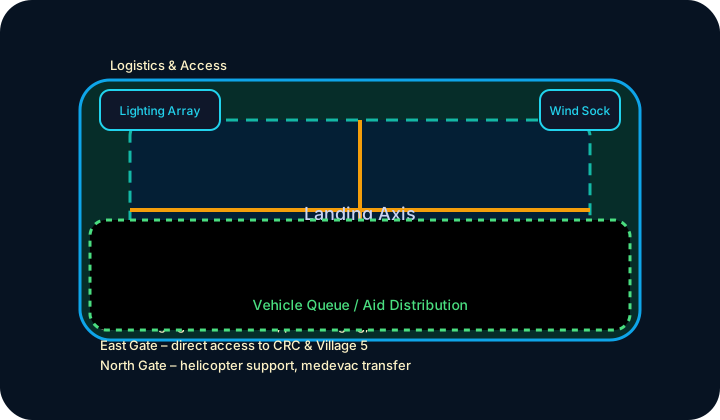
When activated during storms or island-wide outages, the ELZ becomes a FEMA-ready logistics node. The turf grid, perimeter setbacks, and lighting arrays allow:
- Medevac & patient transfer: Staging for helicopter arrivals tied directly to CRC triage areas.
- Supply throughput: Palletized food, water, and medical kits move from the ELZ to Village 5, CRC, and community distribution points.
- Vehicle queue control: Dedicated lanes support National Guard trucks, NGO trailers, and local response vehicles without clogging residential areas.
- Fuel & equipment staging: Reserved pads for temporary fuel bladders, generators, and mobile command posts.
- ICS coordination: Shared radio channels with The Vault ensure that federal, territorial, and nonprofit partners operate on a common picture.
During blue-sky days, the same layout supports soccer leagues, community events, and training exercises that keep crews proficient.
Funding Eligibility & Partnerships
Because the ELZ serves both recreation and disaster response, it qualifies for multiple grant and cost-share pathways:
- FEMA Hazard Mitigation & Public Assistance: Dual-use helipad investments that support mass care and evacuation.
- DHS Preparedness Programs: Infrastructure that strengthens island response capacity.
- DOE Microgrid & Critical-Infrastructure Grants: Lighting, power, and microgrid integration tied to the ELZ.
- USDA Community Facilities: Recreational fields that double as resilience infrastructure.
- USVI Office of Disaster Recovery: Local funding for FEMA-aligned readiness projects.
- Corporate ESG Partnerships: Sponsorship opportunities for field maintenance and emergency supplies.
This mix of mission and eligibility keeps the ELZ cost-effective while meeting federal resilience expectations.
ELZ & Recreation Field Renderings